

It stands as one of the most iconic architectural landmarks of the modern era. Designed by architect Frank Gehry, the project dazzles with a fusion of bold design and technical ingenuity. This article on la-future explores the architectural features that make this building truly exceptional.
The Genesis and Construction Story
The vision for a new concert venue for the Los Angeles Philharmonic originated with Lillian Disney, Walt Disney’s widow. In 1987, she made a founding donation of $50 million to establish the new performance space as a gift to the city and a tribute to her husband’s legacy. This donation laid the groundwork for the project, launching a long-term campaign for planning, fundraising, and the search for an architect.
In 1988, Canadian architect Frank Gehry was selected from numerous contenders in a design competition. Already known for his experimental approach to unusual forms, Gehry finalized the concert hall’s design by 1991, cementing the architectural solutions for both its shape and spatial organization.
Construction began in 1992 with the underground parking garage beneath the future hall. The parking structure was built separately and funded by local government—specifically, Los Angeles County. Completed by 1996 at a cost of approximately $110 million, the parking garage was ready, but the concert hall project itself soon stalled. The reason was a significant budget overrun and a lack of funding, which postponed the building’s realization for several years. The original plan called for a stone facade, but the need to cut costs led to the crucial decision to switch from stone to a stainless steel cladding—a choice that would define the building’s now-famous modern look.
In 1996, the fundraising campaign gained momentum with support pouring in from philanthropists, community leaders, and official entities. Construction contracts for the main building work were signed in November 1999. This officially marked the start of the above-ground construction of the concert hall. On December 8, 1999, a ceremonial groundbreaking took place, a momentous event that kicked off the final phase of construction.
Following the completion of building work, the hall officially opened on October 23, 2003. The total cost of the project, including the underground parking garage, was approximately $274 million. With its opening, the Walt Disney Concert Hall became the newest (fourth) venue within Los Angeles’s The Music Center complex.
Architectural Highlights
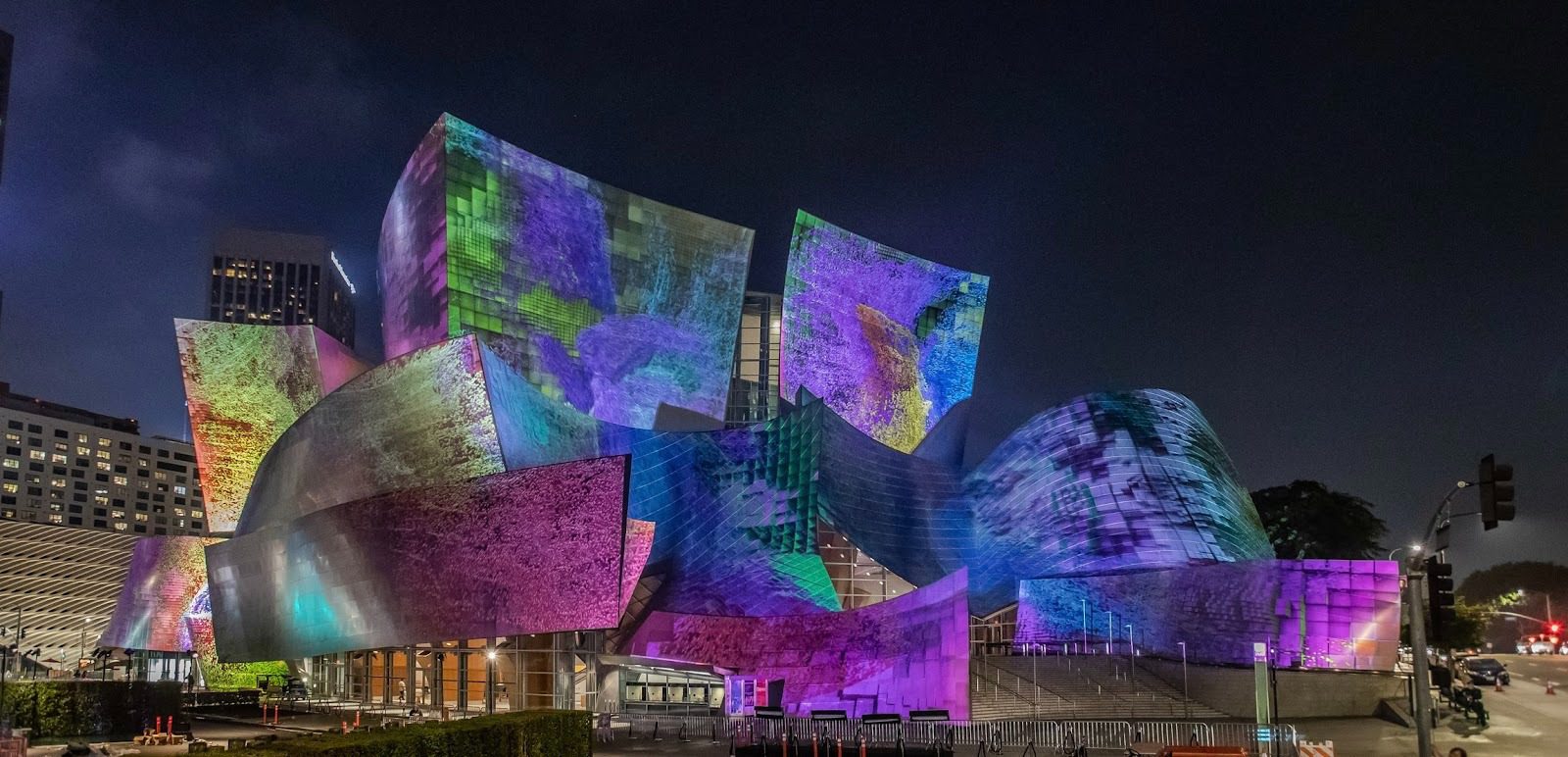
The Concert Hall’s exterior is a true architectural sculpture set within the urban landscape. Far from traditional “rectangular boxes,” the building’s form is dynamic: a steel facade composed of hundreds of specially curved and precisely fitted stainless steel panels creates smooth, billowing forms that appear to flow through space. This effect would have been impossible without complex engineering. A steel framework, made of thousands of structural elements, carries the load, while the metal “skin” elegantly drapes over the frame. The facade is not just aesthetic; it actively engages with light. The curved steel surfaces reflect sunlight during the day and city lights at night, giving the building a shifting, vibrant character. This facade ensures the Concert Hall remains a changing part of the urban landscape, defined by the time of day and the illumination.
Realizing such an ambitious project demanded cutting-edge technology. To translate the complex organic shapes from sketches into a physical structure, the architects employed CATIA software—the same 3D system commonly used in the aerospace and automotive industries. This allowed for the precise design of both the steel frame and the metallic panels. The steel structure, comprising over 11,000 individual elements, and the thousands of cladding panels together create the illusion of a “floating” metal sculpture, seemingly suspended above the ground while holding a space for music and people inside.
Some facade panels, particularly those near the Founders Room and the children’s amphitheater, created intense glare that caused overheating in adjacent apartment buildings and dangerous traffic conditions. In 2005, the problematic panels were buffed to reduce the reflections, effectively solving the issue.
The Interior Experience
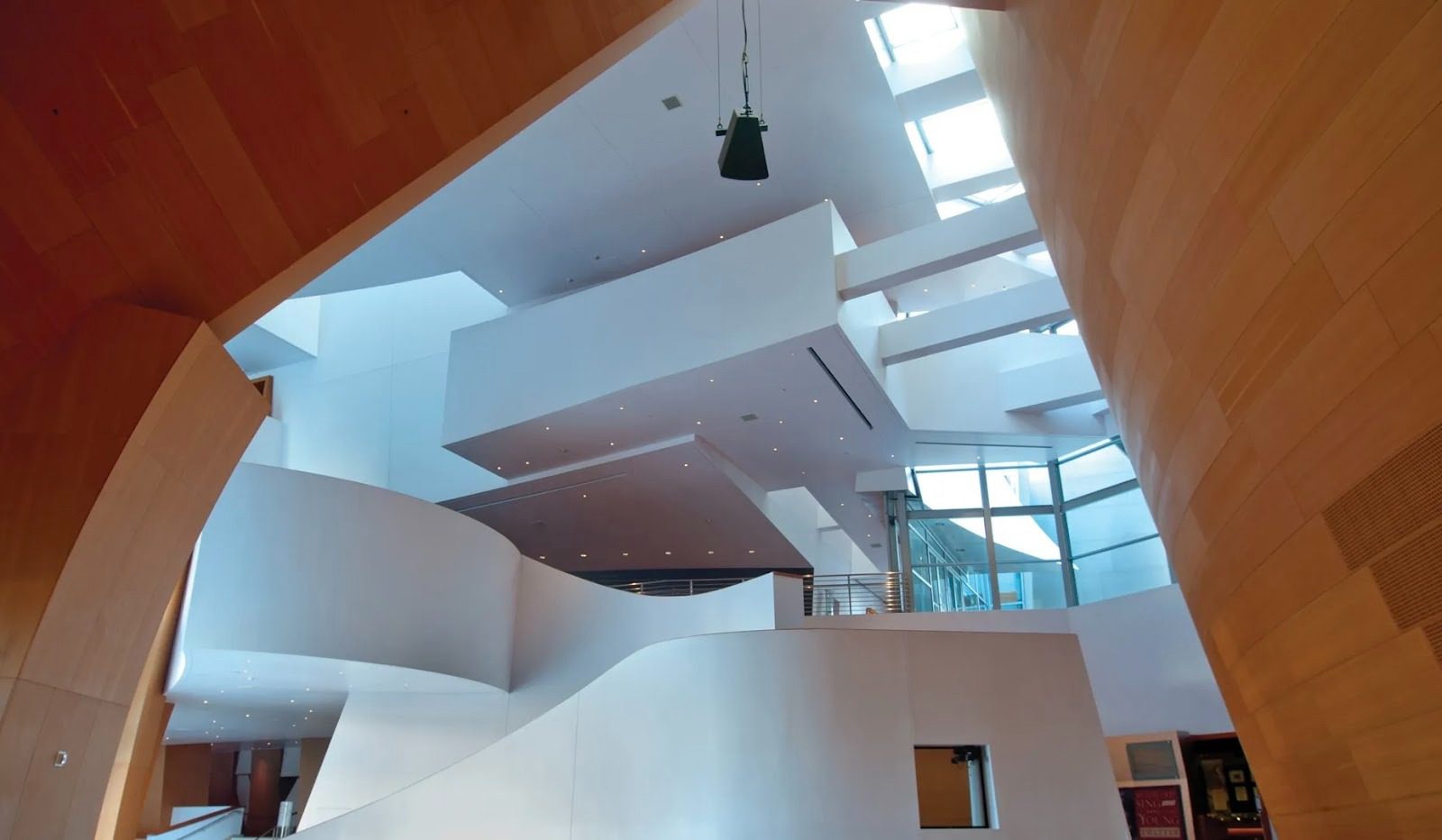
In stark contrast to the cold exterior metal, the concert hall’s interior creates an atmosphere of warmth and acoustic harmony. The hall’s ceilings and walls are clad in panels of Douglas fir wood, designed to complement the curves of the exterior shell. The use of wood serves not only an aesthetic purpose but also a crucial role in acoustics and comfort.
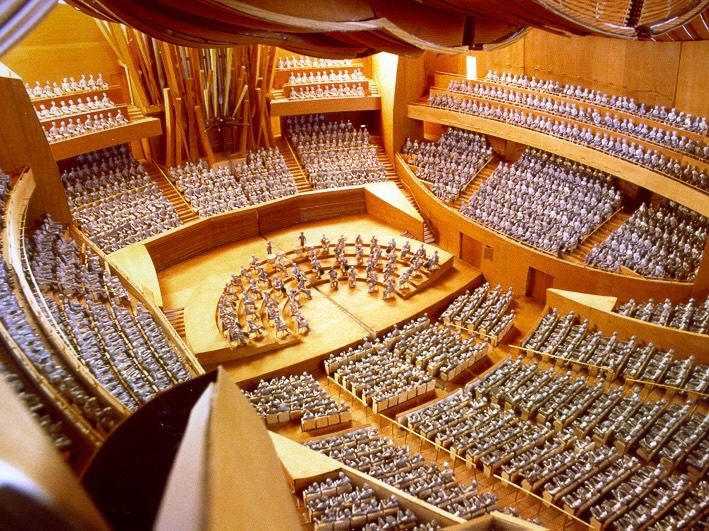
The hall space itself was designed as a single volume free of internal pillars, made possible by a steel roof truss that spans the entire area. This architectural freedom allowed for the creation of a 2,265-seat hall with optimal sound perception and excellent sightlines to the stage from every seat.
The Concert Hall employs “vineyard-style” seating, where the audience is arranged around the stage on terraced sections, much like grapevines on a hill. This approach fosters a sense of intimacy with the performers, blurring the traditional stage-to-hall barrier and making the concert experience more immersive and engaging. This seating arrangement, combined with the lack of columns, ensures uniform acoustic coverage and good visibility from virtually every angle, while the organic forms enhance the feeling of a cohesive space.
Gehry paid exceptional attention to acoustics, even building a 1:10 scale model of the hall for sound testing. The ceiling and walls were constructed from Douglas fir, and the floor from oak, ensuring natural resonance. The hall’s reverberation time measures 2.2 seconds when empty and 2 seconds when occupied. Music critics and the Los Angeles Philharmonic highly praised the acoustics during rehearsals before the official 2003 opening. Esa-Pekka Salonen, the former conductor of the Philharmonic, noted that the true sound of the orchestra could now be heard.
The Concert Organ
One of the hall’s most distinguishing features is its grand concert organ, completed in 2004. Its design was a collaborative effort between Frank Gehry and organ consultant Manuel Rosales. The organ contains 72 stops, 109 ranks, and 6,125 pipes, the largest of which reach 32 feet (9.75 meters). The instrument’s console is movable, allowing it to be placed anywhere on the stage. Donated to Los Angeles County by Toyota Motor Sales, USA, the organ is not only a musical instrument but also an architectural focal point of the hall. Thanks to its unique combination of form and acoustics, the organ creates a multi-dimensional sound that fills the entire concert hall evenly, providing an unparalleled musical experience for both the audience and performers.
The Walt Disney Concert Hall is a successful blend of experimental artistry, engineering prowess, and a deep consideration for the human experience. More than just a building, it is a space where architecture serves music, people, and the city. The contrast between the cold steel facade and the warm wooden interior, and between its sculptural form and acoustic functionality, makes the hall a versatile venue for both world-class concerts and major civic events.