
The Broad, a contemporary art museum in Downtown Los Angeles, became an instant architectural and cultural sensation upon its opening in 2015. Its creation was driven by the founders’ passionate commitment to ensuring public access to their expansive collection of modern and contemporary art. Equally crucial, however, was the building’s architectural solution: the Diller Scofidio + Renfro (DS+R) team brought to life the bold “veil and vault” concept, seamlessly integrating the artistic, functional, and curatorial ideas into a single, compelling structure. More on la-future.
Idea and Construction
The dream of establishing a dedicated museum for their world-class contemporary art collection was realized by philanthropists Eli and Edythe Broad. As early as 2008, they began scouting locations in Los Angeles for a gallery to house their holdings. In August 2010, the definitive plan to build the museum in Downtown LA’s Grand Avenue arts corridor, right next to the already iconic Walt Disney Concert Hall, was announced.
To execute the project, an invited architectural competition was held in 2010, featuring several prominent international firms. The winning design came from the New York-based architectural studio Diller Scofidio + Renfro (DS+R) in collaboration with Gensler. It was this partnership that successfully translated the “veil and vault” concept into a tangible, groundbreaking building.
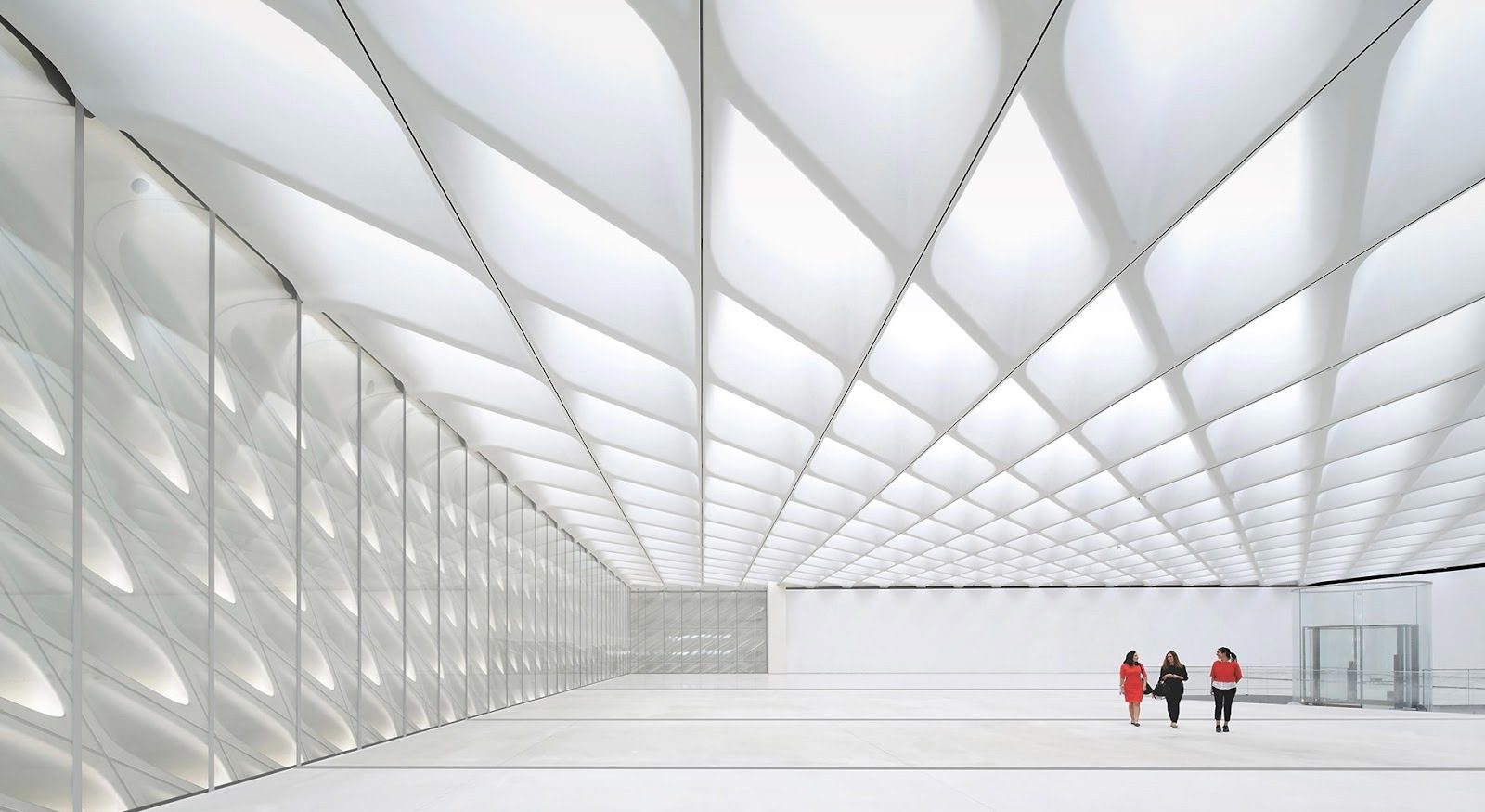
The Broad is strategically located on Grand Avenue, a cultural nexus near other landmark structures, most notably the famous Walt Disney Concert Hall. But instead of attempting to compete with its neighbor’s flamboyant, reflective facade, the architects chose to create a striking contrast: The Broad’s facade is matte, porous, and light-absorbing, serving as a perfect complement to the shimmer and sculptural drama of the Disney Hall. The museum makes an impression by not concealing its “inner workings.” Instead, it elevates them, making the core functions a visible part of the public experience. The massive “vault” and the transparent “veil” establish a balance between the private and the public, between storage and exhibition space. Functionality is expertly merged with aesthetics: natural light, flexible, column-free gallery space, accessibility to the archives, and a comfortable visitor experience all combine to make the museum more than just a repository of art—it is a space for dialogue among residents, tourists, and creativity. The building spans approximately 120,000 square feet and cost around $140 million. Inside, two floors are dedicated to gallery spaces, with the third floor housing the main exhibition hall. The central storage area, the “vault,” simultaneously forms the “floor” for the upper galleries.
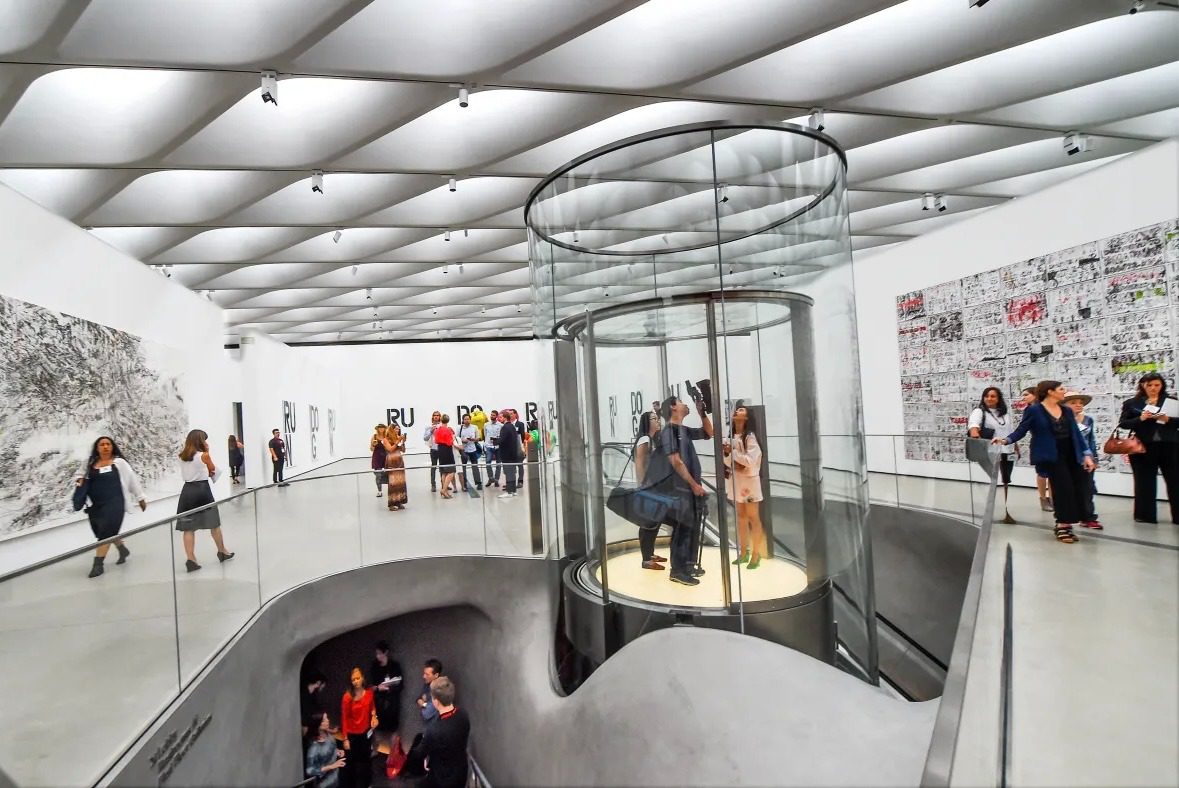
Entry to the museum is through a lobby sheltered beneath the facade’s “veil.” Visitors ascend to the third-floor exhibition halls via a 105-foot escalator or a glass elevator that travels directly through the “vault.” Adjacent to the museum, a 24,000-square-foot public plaza, complete with olive trees and lawns, provides street access—a key component of the urban design concept intended to revitalize Grand Avenue. The museum officially opened its doors on September 20, 2015. Since then, it has become the main platform for displaying over 2,000 works of 20th-century and contemporary art.
In 2024, The Broad announced a major expansion: plans include adding up to 55,000 square feet of new gallery space, effectively increasing its exhibition capacity by an estimated 70%.
The “Veil and Vault” Concept
The core architectural idea behind The Broad was to integrate the collections storage area and the exhibition space within a single architectural volume. The “Vault” is a massive, concrete structure that houses the artworks, offices, archives, and technical areas. Crucially, the vault is not hidden: it is intentionally placed at the building’s center, with the exhibition halls situated above it. Draped around the vault is the light exterior shell—the “Veil”—composed of 2,500 panels of glass fiber reinforced concrete (GFRC) and approximately 650 tons of steel. This “veil” serves multiple purposes: it functions as the facade, filters natural light into the galleries, acts as a structural element, and provides the museum with its iconic, recognizable aesthetic.
Beyond the main galleries, visitors can catch glimpses into the “vault”—through windows in the central area and from the dramatic staircase that descends through the storage volume to the lobby. These views create a sense of transparency and openness while simultaneously maintaining the necessary security for the invaluable works of art.
The Collection
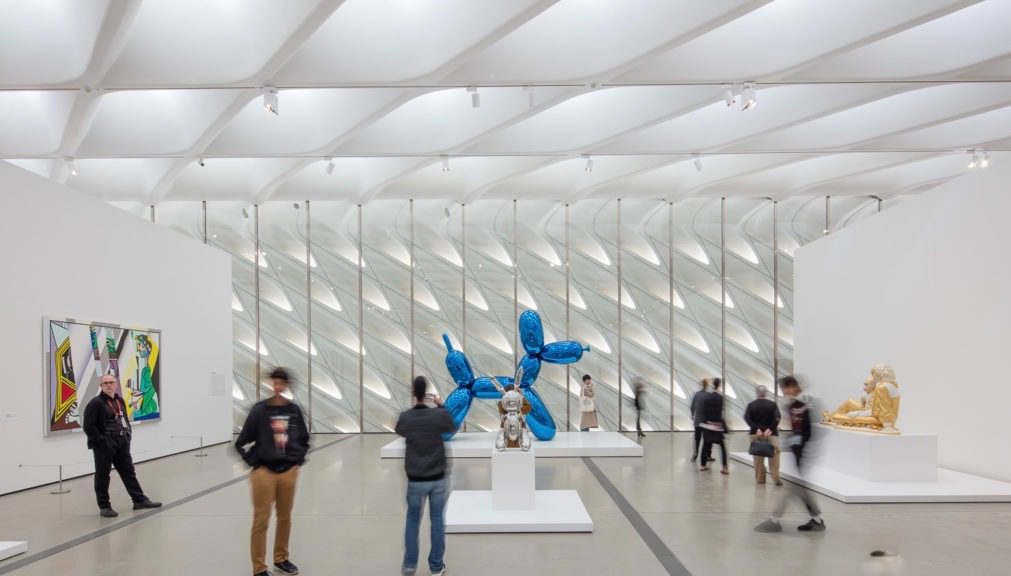
The museum was designed as the permanent “residence” for the collection of contemporary art owned by The Broad Art Foundation. The collection itself comprises nearly 2,000 works, including pieces by renowned artists such as Cindy Sherman, Jeff Koons, Roy Lichtenstein, Ed Ruscha, Andy Warhol, and many other representatives of Pop Art and contemporary movements. Thanks to the “veil and vault” concept, the collection’s storage facility is not an inaccessible archive—visitors can peer into the “vault” during their ascent or descent, which fosters a sense of transparency and underscores the scale of the holdings. The galleries were planned with flexibility in mind: the column-free space and high ceilings allow for diverse exhibition configurations, accommodating everything from large-scale installations to intimate retrospectives.
Since its inception, The Broad has benefited from stable funding and professional management. The museum’s annual budget, approximately $16 million, is funded by endowments. This financial stability allows The Broad to offer free general admission to the public. Since its opening, The Broad has attracted significant attention from the public and media. In its first year, the museum welcomed 753,000 visitors, a number comparable to the attendance of the Los Angeles County Museum of Art (LACMA) in 2011. By 2019, the number of visitors had grown to over 900,000 people.