
For two weeks, the address was simply 1445 N La Brea Ave. From September 17 to 30, nine works by Ukrainian artist Bohdan Bovt hung there, and they were not quite paintings. The walls are bare now, so here is what it was like — for anyone who missed it, and for anyone who wants to remember.
Opening night. It started a few minutes before four on Thursday, September 17. The late-afternoon light was still strong on La Brea when the first visitors began arriving, some pausing outside the entrance before stepping into the cooler, quieter gallery space. By the time the reception was fully underway, about 55 guests had come through the room — artists, members of the local creative community, friends of the project and visitors who had discovered the show independently. There was no formal stage or long program; drinks were served, conversations formed naturally around the works, and the artist spent most of the evening moving between small groups of visitors.
In a brief welcome, Bovt described the exhibition less as a collection of landscapes than as an attempt to work with states of mind through physical form. “I did not want to explain every image,” he said. “I wanted the surface, the light and the viewer to complete the work together.”
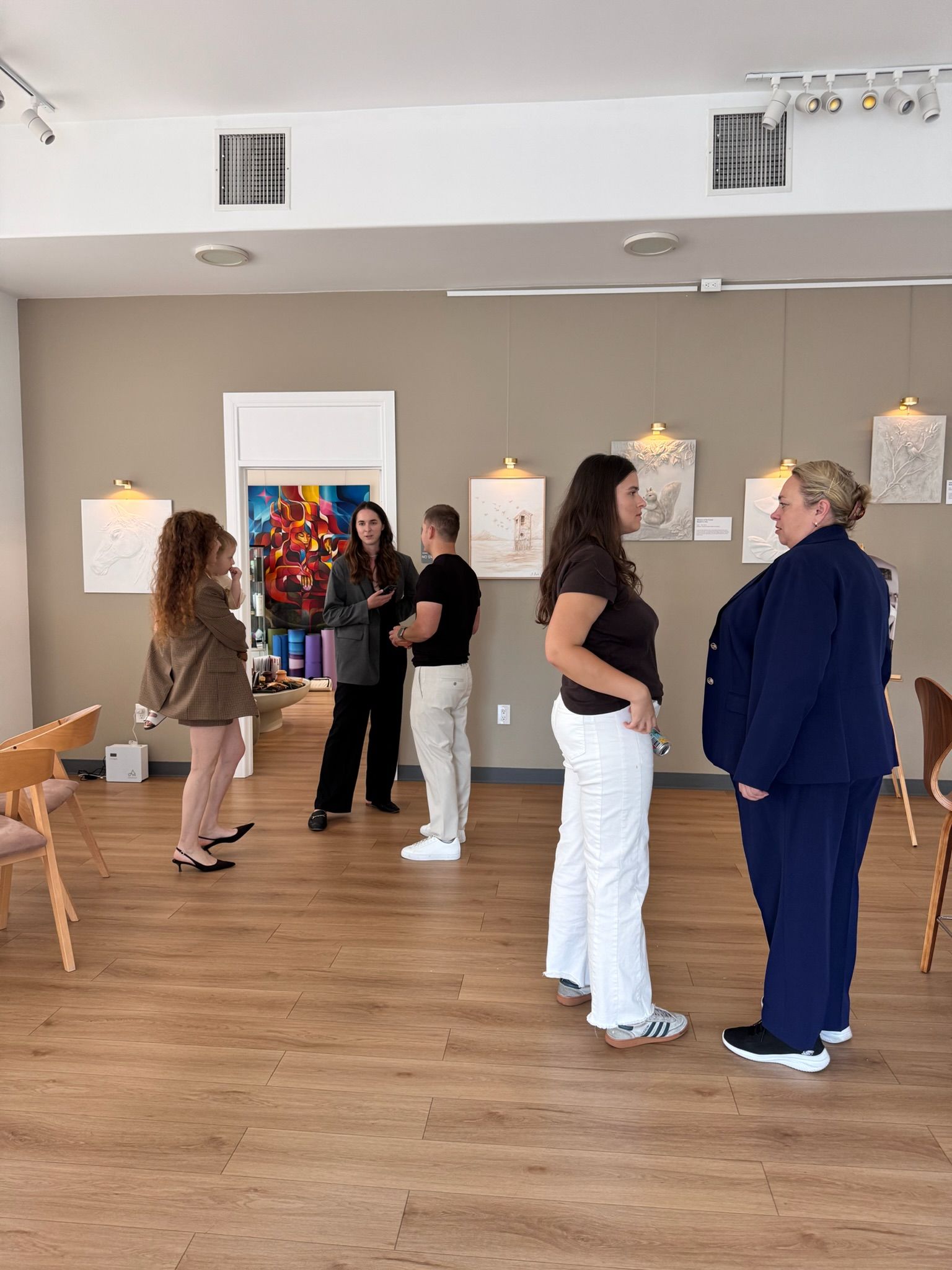
The first look. From the doorway the works read as pictures: mountains, water, stone, open air. Get closer and the pictures stood up. The surfaces rose off the wall — carved, modeled, layered — and the shadows they threw were part of the image. It took a second to realize you were looking at sculpture pretending to be painting. Or the other way around.
The walk. The trick of the room was movement. Walk past a piece and it changed; stand still and it settled. It was the rare show that rewarded you for being in the room rather than on your phone — a photo flattens exactly what makes the work. Visitors learned that quickly. More than once, someone raised a phone, took a picture, looked back at the actual work and then stepped sideways to see what the camera had missed. “It changes when you move,” one visitor remarked during the opening evening, circling back toward the same relief after seeing it from across the room. “The photograph doesn’t really show it.”
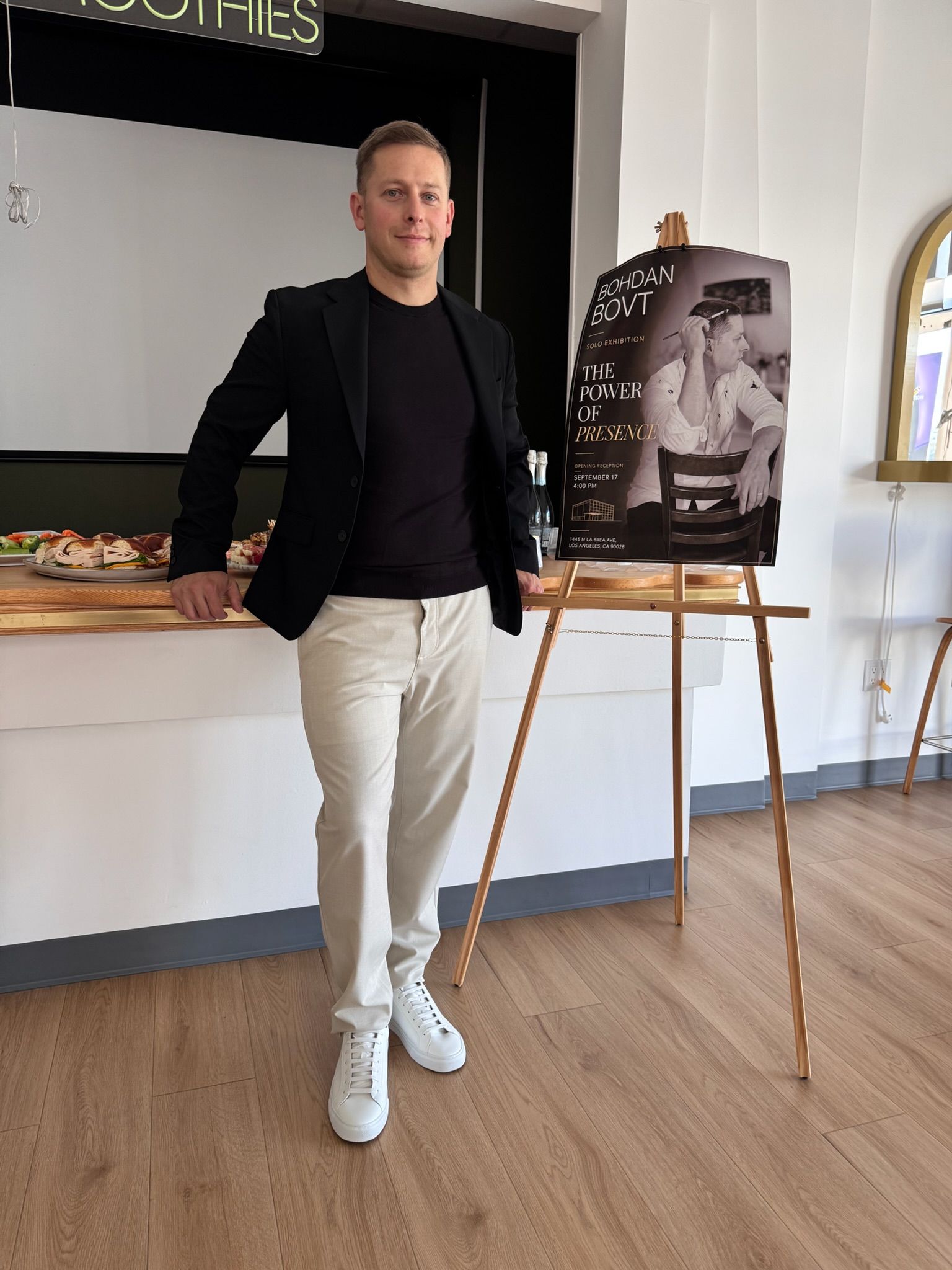
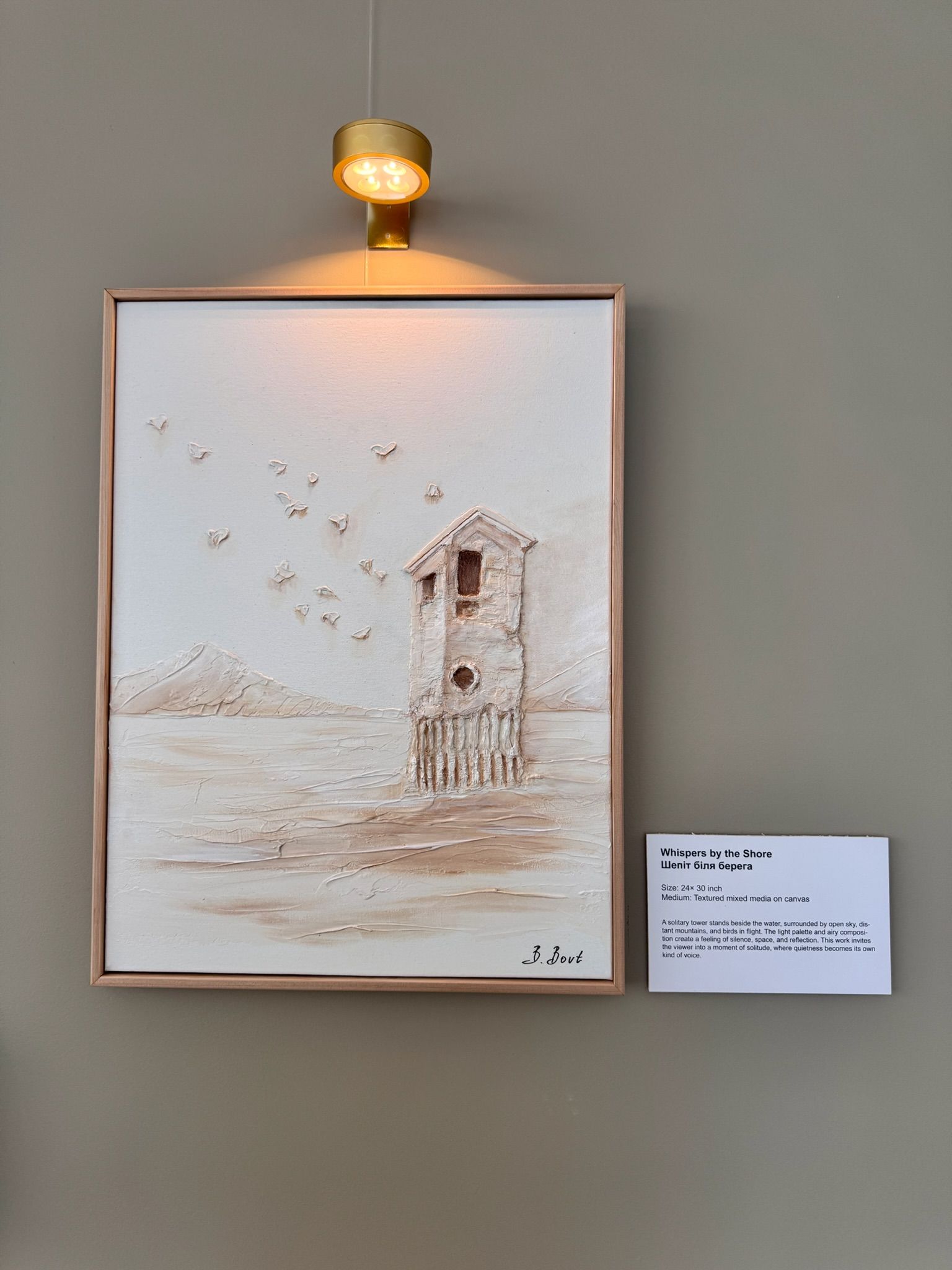
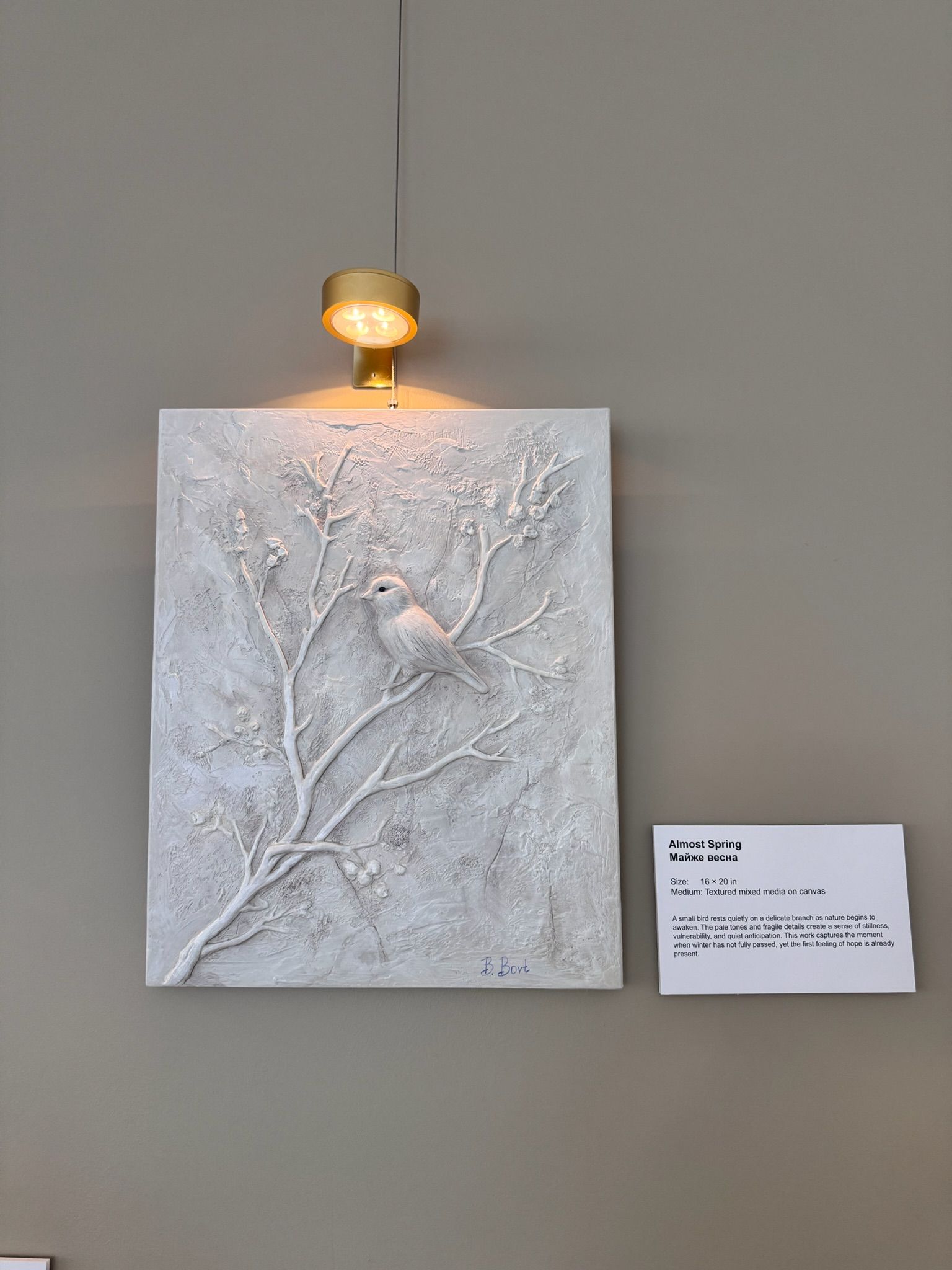
How the room was hung. The nine works were hung as a sequence, and the organizers gave it a shape: stillness first, then hope, then strength, freedom and, at the end, something they called inner awakening. “Almost Spring” and “The Muse without a Name” opened the sequence in a quieter register, followed by “Wisdom of the Forest,” “Echo of the Steppe,” “Whispers by the Shore” and “Golden Autumn.” “Toward the Horizon,” “Alaska Rising” and “Summit of Strength” carried the final part of the exhibition toward greater openness, elevation and visual force. Nobody handed you a map, and nobody told you what each piece meant. That was deliberate. The show wanted you to find your own way in, and to take out whatever you brought with you.
The mountain. If one work became the show’s meeting point, it was the monochrome mountain, “Summit of Strength.” No color to lean on, just relief and the gray that shadow makes. It repeatedly became one of the works around which visitors stopped longest. Some first saw a mountain landscape; others noticed the surface itself before they read the image. From straight on, it could appear restrained and almost graphic. Move a step to either side and the peaks separated, the recesses darkened and the entire composition gained weight.
The man by the wall. Bohdan Bovt was rarely stationary during the opening reception. He spoke with visitors about how individual works had been built, pointed out areas where shallow relief changed under side lighting and repeatedly encouraged people to look at the pieces from more than one angle. During the following days, conversations around the work tended to return to the same question: where does the painting end and the sculptural object begin? Bovt’s answer was usually to resist the distinction altogether. “For me, the surface is not a background,” he said. “It is part of the image.”
His story is not the usual art-school one. Before he ever touched canvas, he spent four years, from 2005 to 2009, learning wood carving, birch-bark carving and carpentry at a vocational art school in Ivano-Frankove, in western Ukraine. You could see it in how the surfaces were cut. Then came painting — and research: he has published papers on gypsum mixtures and on how people see relief under different light. His line on the work: “A flat surface shows an image. In each relief, I try to give form to what we cannot see but can always feel.”
The résumé, for anyone who asked. A Grand Prix at Ukraine’s national painting triennial in 2022. A work in the National Art Museum of Ukraine in Kyiv, donated in 2020. Fairs in Barcelona, Berlin and Brussels. Commissions for private collections in Belgium and the Netherlands. Four years on an international art jury. And home, these days, is Juneau, Alaska — a city you can only reach by plane or boat. This was his first solo show in Los Angeles.
The last day. September 30 was quieter than opening night. There was no formal closing reception; instead, the last visitors arrived in small groups through the afternoon. The atmosphere felt less like an event and more like the final hours of a room that had already developed its own rhythm. Bovt spoke with several of the last guests, revisited the installation piece by piece and stayed until the gallery began preparing to close the exhibition.
“The most important thing for me was seeing people spend time with the work,” Bovt said of the two-week run. “Some came back to the same piece more than once, and that is probably the best response I could ask for.”
What we’ll remember.
- That the best way to see a painting was to walk past it.
- That a monochrome mountain could hold a room without a single bright color.
- That the artist learned his craft on birch bark before he ever touched canvas.
- That visitors kept returning to works they thought they had already seen, only to discover that a different angle — or a different patch of light — had changed them.
If you missed it. There is no announced second venue for “The Power of Presence” yet. Bovt is returning to his studio practice in Juneau, where he plans to continue developing the relief-based approach shown in Los Angeles and work on a new group of pieces centered on landscape, material and changing light.
A tip for next time: go in the late afternoon. Stand still in front of the mountain for a full minute. Then take one step to the left.

